If you've ever picked up a nice watch and noticed a small window on the back showing tiny gears spinning, you were looking at a mechanical movement and once you understand what's happening in there, it's hard not to be a little fascinated.
A mechanical watch is a timepiece that runs entirely on physical, mechanical energy instead of a battery. No electronics, no chip, no quartz crystal buzzing away. Just springs, gears, and levers, all working together the same way they have for over 300 years.
The Basic Idea
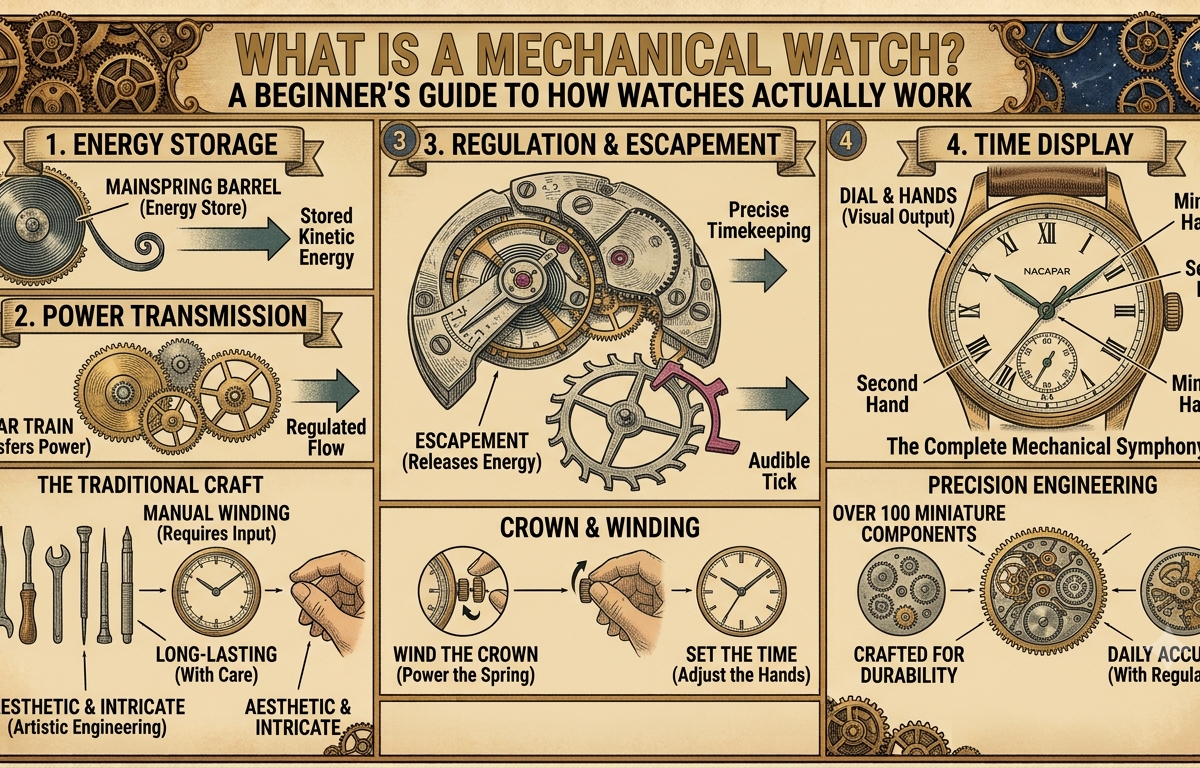
Every mechanical watch stores energy in a coiled metal ribbon called the mainspring. As the mainspring slowly unwinds, it releases energy through a gear train, which turns the hands. But unwinding energy in a controlled, steady way is the hard part if it all released at once, the hands would spin wildly for a few seconds and then stop.
That's where the escapement comes in. It's the beating heart of the watch, releasing tiny bursts of energy at a fixed rate usually somewhere between 3 and 5 times per second which is what creates that smooth "sweeping" second hand you see on mechanical watches, instead of the tick-tick-tick of a quartz watch.
Manual vs Automatic
There are two types of mechanical watches:
Manual (hand-wound): You wind the crown yourself, typically once a day, to keep the mainspring charged.
Automatic (self-winding): A weighted rotor swings freely inside the case as you move your wrist, winding the mainspring for you. As long as you wear it regularly, you never need to manually wind it.
Most watches sold today under the "automatic" label fall into this second category, and it's usually the better starting point for a first mechanical watch since it requires less daily maintenance.
Why People Still Wear Them
A quartz watch, powered by a battery and a vibrating crystal, is objectively more accurate and cheaper to produce. So why do mechanical watches still exist, and why do people pay a premium for them?
The honest answer is craftsmanship and connection, not accuracy. A mechanical watch is a small machine you can watch operate, one that's often serviceable for generations, and one where tiny variances in finishing, decoration, and engineering separate an entry-level piece from a high-end one. For many collectors, wearing one is closer to wearing a piece of functional art than simply checking the time.
What to Expect in Terms of Accuracy
This is the one area where new buyers are sometimes surprised. Mechanical watches are not perfectly accurate they typically gain or lose somewhere between -10 and +20 seconds per day depending on quality, position, and temperature. Higher-end movements that carry chronometer certification are held to tighter tolerances, but even those aren't as precise as a $10 quartz watch. That's not a flaw; it's simply the nature of a mechanical system, and most collectors come to see it as part of the charm rather than a downside.
A Simple Way to Remember It
If it needs a battery, it's quartz. If it needs winding or wrist motion, it's mechanical. Everything else the finishing, the complications, the price builds on top of that one basic distinction.
Understanding this single concept is the foundation for everything else in watch collecting, from picking your first piece to understanding why two watches that look similar can be priced worlds apart.