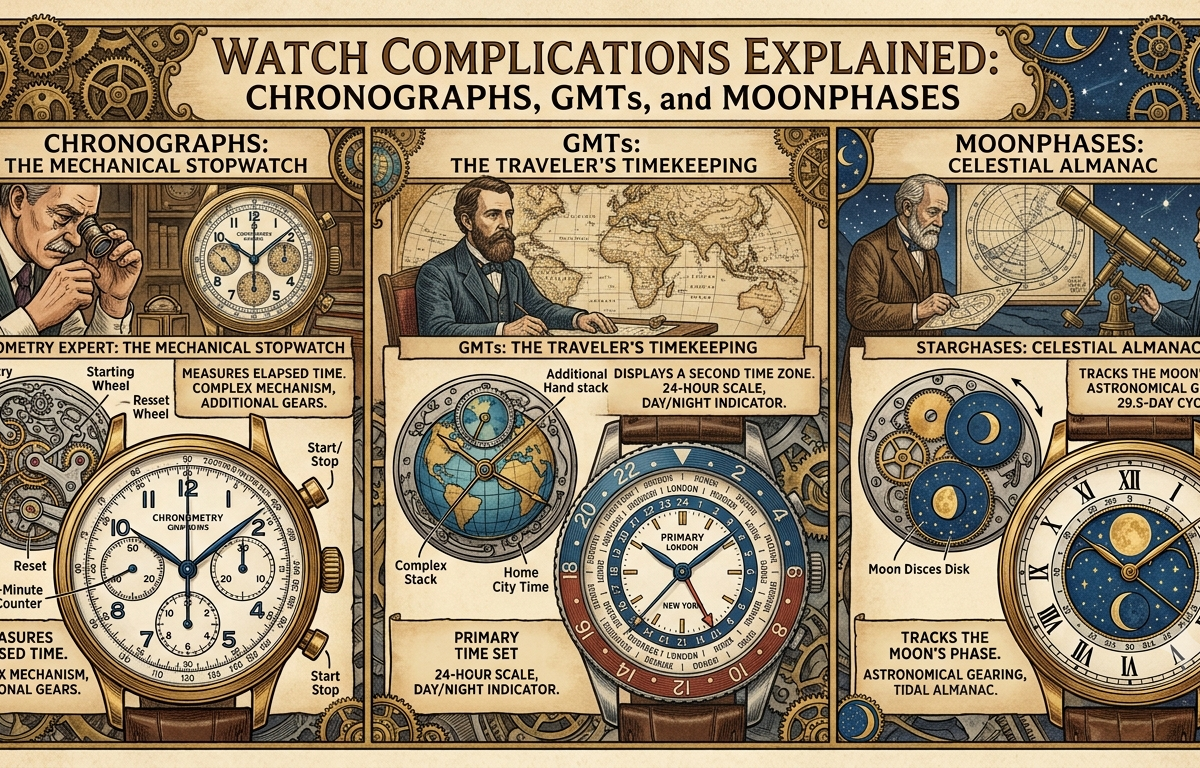
If you've spent any time browsing watches, you've probably come across the term "complication." It sounds intimidating, but the concept is simple once explained clearly.
What Is a Complication?
In watchmaking, a complication refers to any function a watch performs beyond simply displaying the hours, minutes, and seconds. The more complications a watch has, the more mechanically complex and often more expensive it tends to be, since each added function requires additional gears, springs, and engineering inside an already small case.
Chronograph
A chronograph is essentially a built-in stopwatch. It usually features one or more sub-dials and a pusher (or two) near the crown that start, stop, and reset a timing function, separate from the regular timekeeping. Chronographs originated for practical uses like timing races, military operations, and navigation calculations, and remain one of the most popular complications today because they add visual complexity along with genuine function.
GMT / Dual Time Zone
A GMT complication adds a second, independent hour hand (usually longer or differently colored) that points to a 24-hour scale, allowing the wearer to track a second time zone at a glance. This complication became especially popular among pilots and frequent travelers, and remains a favorite for anyone who regularly deals with multiple time zones.
Moonphase
A moonphase complication displays the current phase of the moon using a rotating disc visible through a small window on the dial, typically completing a full cycle roughly every 29.5 days. While not particularly "useful" in a modern sense, it's beloved for its poetic, almost artistic quality, and is often paired with other complications on higher-end dress watches.
Date and Day-Date Complications
These are the simplest and most common complications a small window showing the date, sometimes paired with the day of the week. Simple as they sound, they still require additional mechanical parts to advance correctly, including handling months with fewer than 31 days.
Power Reserve Indicator
This complication shows how much stored energy remains in the mainspring, similar to a fuel gauge. It's particularly useful on manual-wind watches, letting the wearer know when it's time to rewind before the watch stops.
Perpetual Calendar
A more advanced complication, a perpetual calendar automatically adjusts for months of different lengths and even leap years, without needing manual correction for decades. This is considered one of the more prestigious and mechanically impressive complications due to the complexity involved in building it into a small movement.
Why Complications Matter to Collectors
Understanding complications isn't just trivia it directly affects price, use case, and long-term satisfaction with a watch. A collector who travels frequently might prioritize a GMT function, while someone drawn to mechanical artistry might gravitate toward a perpetual calendar or moonphase. Recognizing what each complication actually does (versus what simply looks impressive on a dial) helps you buy watches that genuinely fit how you'll use them, not just how they look in photos.