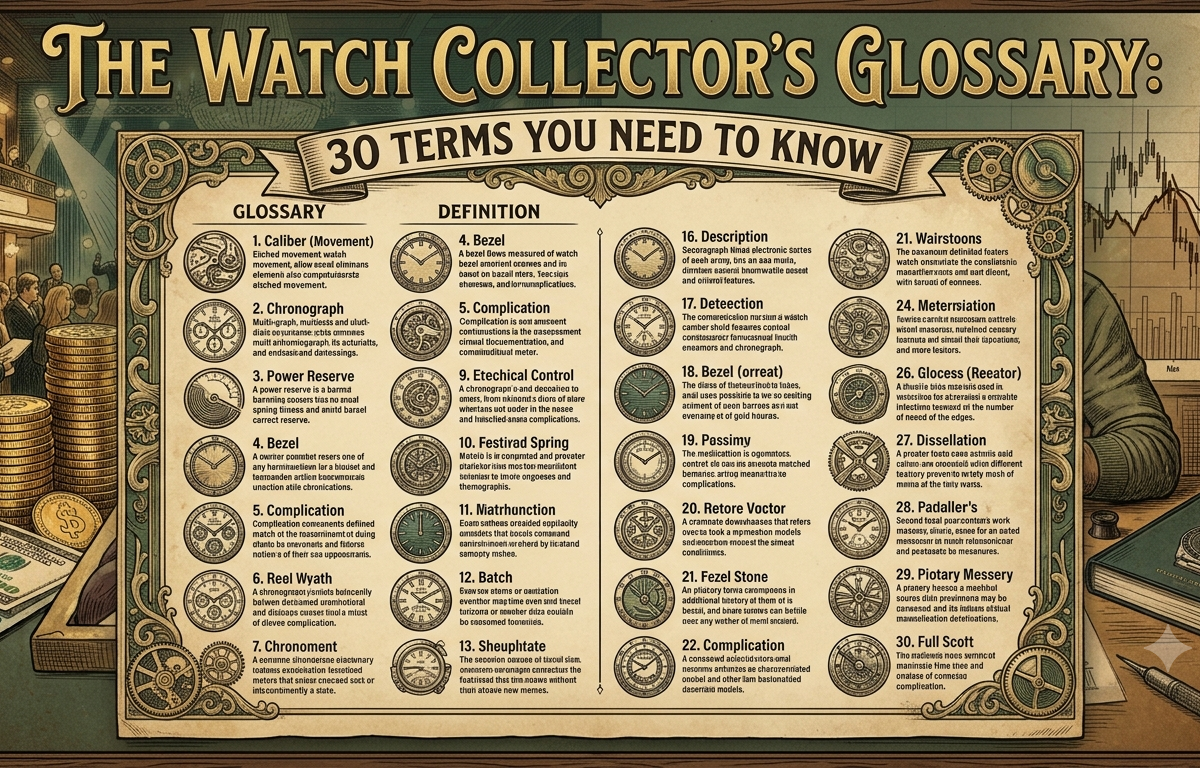
Watch collecting has its own language, and it can feel overwhelming at first. This glossary breaks down 30 of the most common terms you'll encounter, explained simply.
Case and Design Terms
Lug-to-lug: The distance from the top edge to the bottom edge of the watch case, which affects how the watch actually sits on your wrist often more important than the diameter alone.
Bezel: The ring surrounding the watch face, which can be fixed, rotating, or used to track elapsed time (common on dive watches).
Crystal: The transparent cover protecting the dial, typically made of mineral glass, acrylic, or sapphire crystal (the most scratch-resistant option).
Lume: Luminescent material applied to hands and markers so the dial is visible in low light.
Crown: The small knob on the side of the case used to set the time, date, and in manual watches, wind the movement.
Case back: The rear panel of the watch case, sometimes solid and sometimes an "exhibition" case back with a clear window showing the movement.
Movement Terms
Movement: The internal mechanism that powers the watch, whether quartz, automatic, or manual.
Caliber: The specific model or reference number of a movement, used to identify which exact engine is inside a watch.
Mainspring: The coiled spring that stores energy in a mechanical watch.
Escapement: The mechanism that regulates the release of energy from the mainspring, controlling timekeeping accuracy.
Rotor: The weighted, swinging component in an automatic watch that winds the mainspring as the wearer moves.
Power reserve: How long a mechanical watch will keep running once fully wound, without additional winding or wrist motion.
Jewels: Small synthetic rubies used at friction points inside a movement to reduce wear, commonly counted and listed as a spec (e.g., "21 jewels").
Amplitude: A measure of how far the balance wheel swings, used by watchmakers to assess a movement's health and accuracy.
Complications
Complication: Any function beyond basic timekeeping, such as a date, chronograph, or moonphase.
Chronograph: A stopwatch function built into the watch.
GMT: A complication that displays a second time zone using an additional hand and 24-hour scale.
Perpetual calendar: A complication that automatically adjusts for varying month lengths and leap years.
Tourbillon: A rotating mechanism designed to counteract the effects of gravity on accuracy, generally considered a high-end, prestige complication.
Buying and Market Terms
Reference number: The unique model identifier used by manufacturers to distinguish between different versions of a watch.
Full set: A secondhand watch sold with its original box, papers, and accessories.
Franken-watch: A watch assembled from mismatched or non-original parts, often to disguise damage or fake authenticity.
Grey market: Watches sold by unauthorized (but not necessarily illegitimate) dealers, often at a discount from retail price.
MSRP: Manufacturer's suggested retail price, i.e., the official listed price before any discounts.
Style and Category Terms
Dive watch: A watch designed for underwater use, typically featuring high water resistance and a rotating timing bezel.
Dress watch: A slim, minimalist watch designed for formal occasions.
Field watch: A rugged, simple watch originally designed for military use, valued for legibility and durability.
Pilot watch: A watch historically designed for aviators, often featuring large, legible dials and sometimes a slide-rule bezel.
Skeleton watch: A watch with a partially or fully see-through dial, exposing the movement's inner workings.
Homage watch: A watch that closely mimics the design of a famous model without being an outright counterfeit, typically sold under its own brand name.
Why Learning These Terms Matters
Once these terms become second nature, reading a watch listing, understanding a review, or having a conversation with another collector becomes far easier and you'll start noticing these details in watches you already own, which often deepens your appreciation for pieces you thought you already understood.