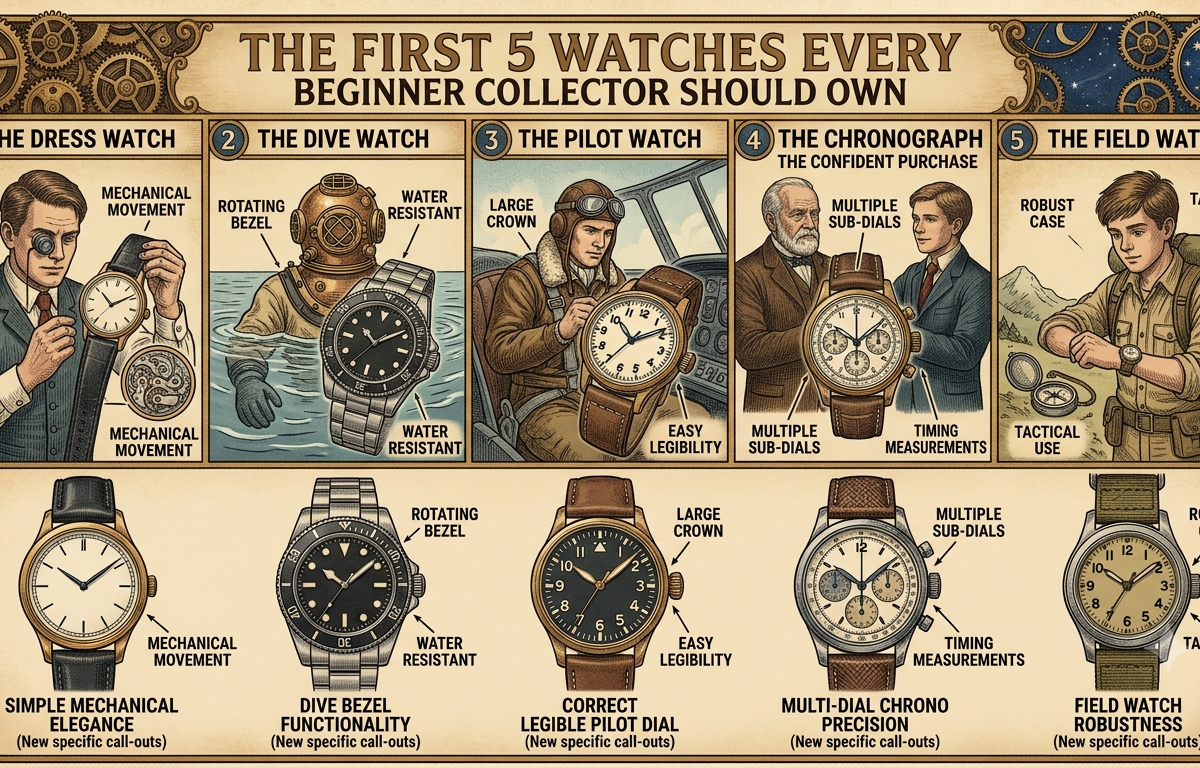
One of the most common questions new collectors ask is "what should I buy first?" The honest answer isn't a specific model it's a type of watch that teaches you something about the hobby. Here's a framework for the first five watches that will give any beginner a well-rounded foundation.
1. A Reliable, Affordable Quartz Watch
Before spending serious money, start with an inexpensive, accurate quartz watch. This isn't a "starter" watch you'll outgrow and regret it teaches you what daily accuracy actually feels like, and gives you a dependable everyday piece while you learn more about the hobby before committing bigger budgets elsewhere.
What it teaches: Baseline accuracy expectations and everyday durability.
2. Your First Automatic Watch
This is often the emotional turning point for new collectors the first time you feel a rotor winding as you shake the watch, or watch the seconds hand sweep smoothly instead of ticking. Look for an entry-level automatic with an exhibition case back so you can actually see the movement working.
What it teaches: How mechanical watches feel and behave differently from quartz, including their accuracy trade-offs and winding needs.
3. A Dive Watch
Dive watches are a cornerstone of the hobby because they combine function (water resistance, rotating bezels, luminous markers) with a design language that has barely changed in 60-plus years. Owning one teaches you to appreciate purpose-built tool-watch design.
What it teaches: How form follows function, and why certain design details (bezel, lume, crown guards) exist for practical reasons.
4. A Dress Watch
A slim, simple, elegant watch usually with a leather strap, minimal dial text, and no rotating bezel or big complications rounds out your collection for formal occasions. This is often where collectors first appreciate subtlety: fine finishing, proportion, and restraint over flashy features.
What it teaches: That "less" can be a design choice, not a limitation, and that finishing quality matters as much as specs.
5. A Chronograph
A chronograph (a watch with stopwatch functionality, usually shown through sub-dials) introduces you to "complications" features beyond simply telling time. It's a great next step once you're comfortable with the basics, because it teaches you to read a busier dial and understand added mechanical complexity.
What it teaches: How additional functions are engineered into a movement, and how dial legibility becomes more challenging as complications are added.
Why This Order Matters
Rather than chasing hype or a specific brand name first, this progression is designed around concepts: accuracy, mechanical appreciation, function-driven design, minimalist design, and complications. By the time you own all five, you won't just have five watches you'll have a genuine, practical understanding of what separates different watches from each other, which makes every future purchase more informed and more satisfying.
A collection built this way also tends to age well. You're not buying five of the same thing, and you're not buying purely on impulse you're building a foundation you can keep adding to for years.