This is probably the single most common question a new watch buyer asks, and it's a good one because the movement inside a watch affects everything from price and accuracy to how much maintenance it needs.
Let's break down all three honestly, without any brand bias.
Quartz Movements
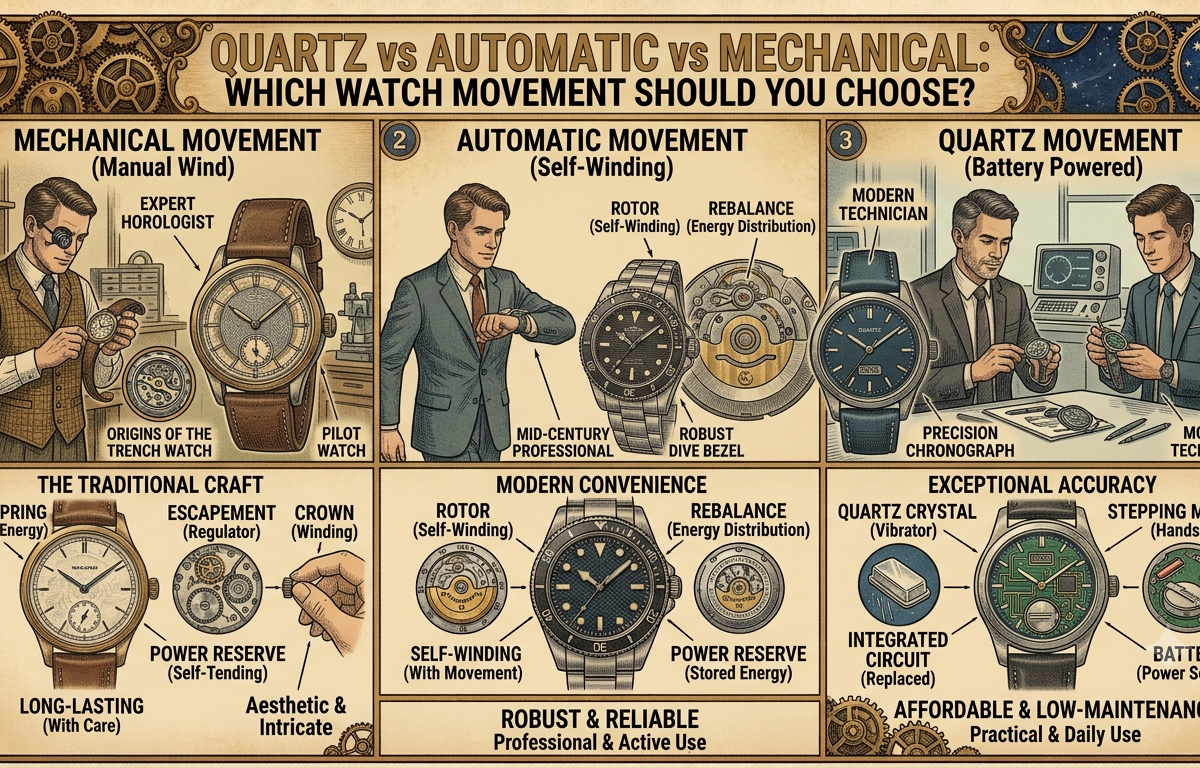
A quartz watch runs on a battery, which sends an electric current through a small quartz crystal. The crystal vibrates at a precise, consistent frequency, and a circuit converts those vibrations into the ticking motion of the hands.
Pros:
Extremely accurate (typically within seconds per month)
Low maintenance just a battery change every 1-3 years
Usually more affordable
Very durable and shock-resistant
Cons:
Considered less "romantic" or craft-driven by collectors
The battery will eventually die and needs replacing
Fewer of them are considered heirloom or investment pieces
Automatic (Self-Winding Mechanical) Movements
An automatic watch has no battery at all. Instead, a rotor inside the case spins as your wrist moves, winding the mainspring that powers the watch.
Pros:
No battery ever needed
Smooth sweeping second hand
Often has visible, appreciated craftsmanship (some have exhibition case backs)
Can be serviced and repaired for decades, sometimes generations
Cons:
Less accurate than quartz (typically off by seconds per day, not per month)
Needs regular wear or a watch winder to stay powered
Requires servicing every several years, which costs money
Usually more expensive than a comparable quartz watch
Manual (Hand-Wound) Mechanical Movements
These work identically to automatics, minus the self-winding rotor. You wind the crown yourself, typically daily.
Pros:
Simpler mechanism, sometimes thinner cases as a result
A more hands-on, ritualistic experience for enthusiasts
Often the entry point into "serious" horology
Cons:
You must remember to wind it or it stops
Same accuracy trade-offs as automatics
So Which One Should You Choose?
There's no universally "correct" answer it depends on what you value:
Want reliability and low cost? Quartz is the practical choice.
Want the craft, the story, and something to grow a collection around? Automatic is the classic starting point for new collectors.
Want a deeper, more deliberate daily ritual? Manual winding appeals to a specific type of enthusiast.
Many experienced collectors actually own all three types, wearing quartz for travel or rough conditions, and mechanical pieces for daily wear or special occasions. There's no rule that says you have to pick just one lane and figuring out which one you gravitate toward is part of the fun of building a collection.