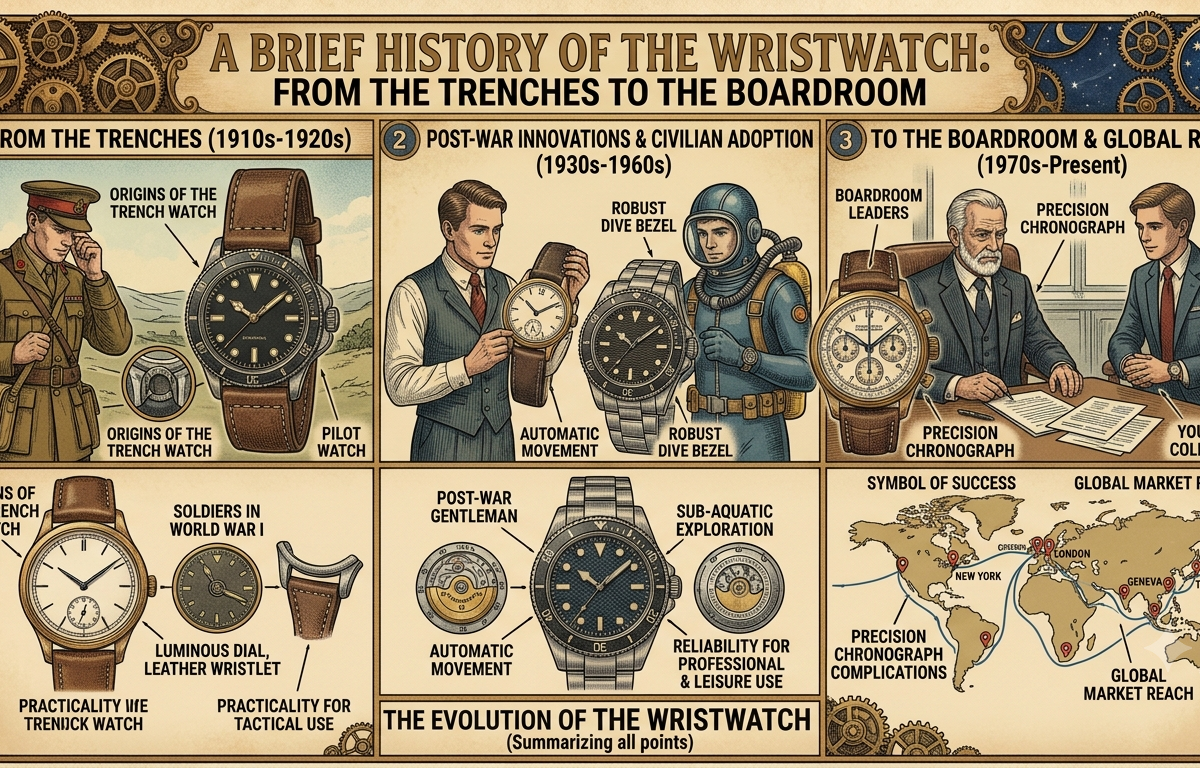
It's easy to take the wristwatch for granted, but it's a surprisingly recent invention with a fascinating backstory rooted in war, aviation, and changing social norms.
Pocket Watches Came First
For most of watchmaking history, timepieces were carried, not worn. Pocket watches dominated from the 1600s through the late 1800s, and wearing a watch on the wrist was, for a long time, considered a woman's accessory or even mildly impractical for serious use.
The Turning Point: Military Necessity
The shift began around the late 19th and early 20th centuries, largely driven by soldiers and aviators. Coordinating troop movements, artillery timing, and aerial maneuvers required both hands free pulling a pocket watch out mid-battle simply wasn't practical.
During the Boer War and later World War I, soldiers began strapping pocket watches to their wrists using leather cups and straps, a workaround that quickly evolved into purpose-built wristwatches. By the end of World War I, the wristwatch had shed its earlier reputation and become associated with practicality and modern military technology.
The Interwar Boom
Through the 1920s and 30s, wristwatches became mainstream. Waterproofing, shock resistance, and self-winding mechanisms were all developed during this period, turning the wristwatch from a battlefield tool into an everyday object for the general public.
The Quartz Revolution
The next seismic shift came in the 1960s and 70s with the development of quartz technology. Quartz watches were far more accurate and much cheaper to produce than mechanical ones, and their arrival on the mass market often referred to as the "quartz crisis" devastated traditional mechanical watchmaking industries that couldn't compete on price or precision.
Many long-standing mechanical watchmakers closed during this period, unable to keep up with inexpensive, highly accurate quartz alternatives flooding the market.
The Mechanical Revival
Interestingly, mechanical watches didn't die they repositioned themselves. Rather than competing on accuracy, mechanical watchmaking leaned into craftsmanship, heritage, and emotional value. Through the 1980s onward, mechanical watches were increasingly marketed and understood as objects of engineering artistry rather than pure timekeeping tools, a positioning that persists strongly today.
Smartwatches: The Newest Chapter
Since the mid-2010s, smartwatches have introduced yet another category entirely timepieces that also function as computers. Rather than replacing mechanical and quartz watches, smartwatches have largely carved out their own lane, with many people now owning both a traditional watch for its craftsmanship or style, and a smartwatch for fitness tracking and notifications.
Why This History Matters to Collectors
Understanding this timeline helps explain a lot about the watch world today why certain design elements (like military-style dials or pilot watch features) persist, why mechanical watches are marketed the way they are, and why quartz and mechanical movements coexist rather than one having simply "won." The wristwatch's 100-plus year journey from battlefield necessity to fashion statement to engineering showpiece is really a story about how objects find new meaning once their original purpose is replaced by something more efficient.